 Available in US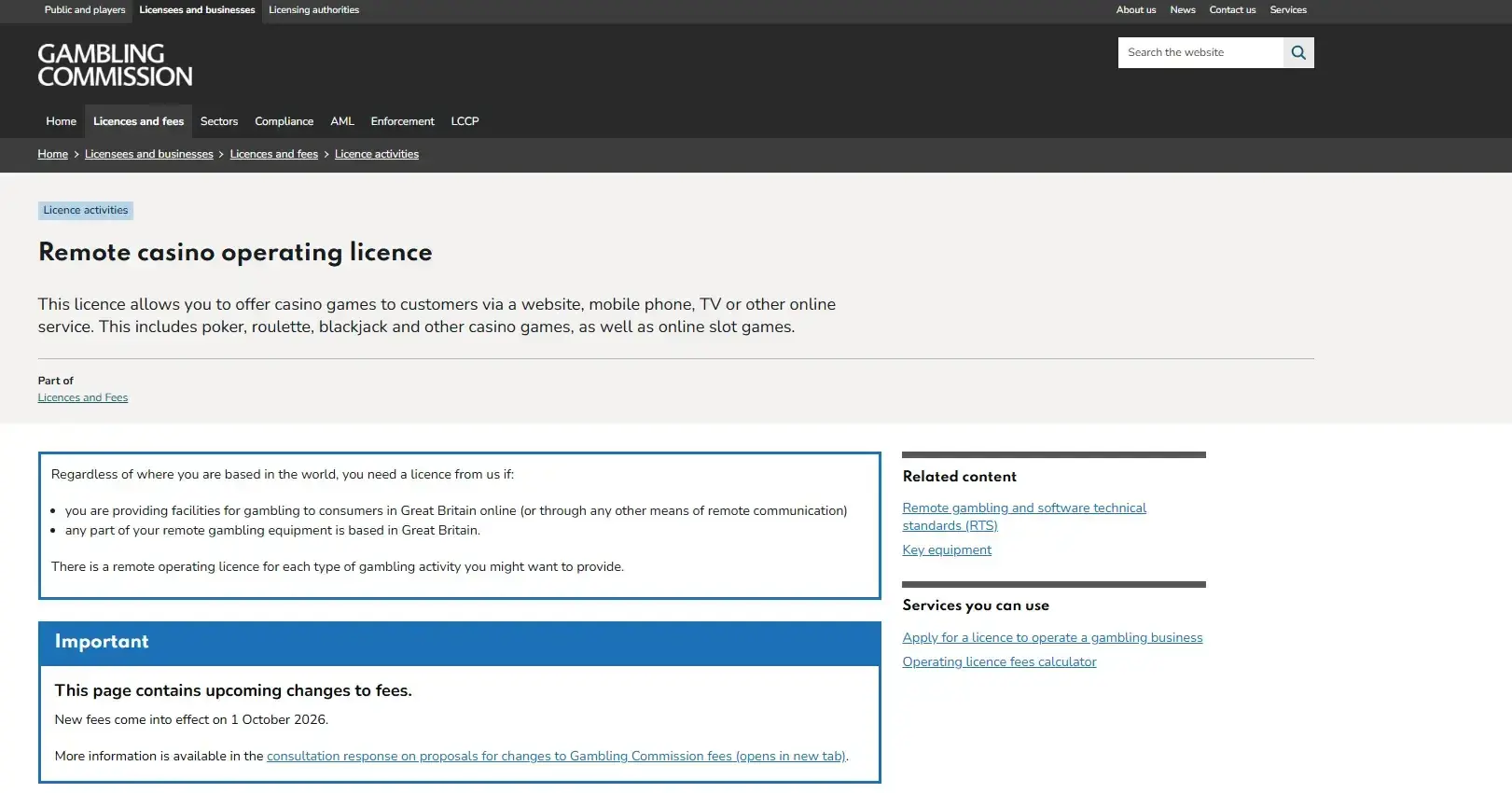
Rollino licensing: the two facts that must not be confused
Independent current sources identify Rollino with a Curaçao Gaming Authority licence. Separately, the available evidence did not establish a UK Gambling Commission public-register hit for Rollino or Fortuna Games N.V. These are different facts and should be stated separately rather than treating an offshore licence as equivalent to a British one.
The UK Gambling Commission says businesses providing remote gambling to consumers in Great Britain need the appropriate Commission licence regardless of where the business is based. Current Commission guidance for online safety likewise tells British consumers to check the public register to see whether a site is licensed and what activities it may offer.
For that reason, a UK reader should not infer UKGC status from a Curaçao licence, an English-language website or the ability to reach a casino page. The relevant British status is a Gambling Commission licence and public-register record.
The full picture is in the Rollino review for UK players.
What the Curaçao evidence does establish
The assigned brand evidence supports identifying a Curaçao Gaming Authority licence in Rollino’s licensing context. That is meaningful as a statement about the regulatory framework associated with the brand. It does not, by itself, establish permission to serve every other jurisdiction.
Licences are jurisdiction-specific. A casino can be associated with one regulator while another market imposes its own licensing requirement. The correct comparison is therefore not “licensed versus unlicensed” in the abstract, but which licence is relevant to the consumer and activity being discussed.
This page avoids extending the Curaçao fact into unsupported legal conclusions about a British player’s individual circumstances. It also avoids claiming that offshore regulation provides protections identical to the UKGC regime.
Great Britain requires its own remote-gambling licence
The Gambling Commission’s current licensing pages state that, regardless of where a business is based in the world, a Commission licence is required when it provides remote gambling facilities to consumers in Great Britain. This is the key regulatory benchmark for a UK-focused Rollino review.
The available evidence session did not establish a UKGC register hit for Rollino or Fortuna Games N.V. The careful wording is therefore that a UKGC licence was not verified in this research, not that we have proved every possible legal fact about the operator. Public-register evidence is the relevant source for a positive UKGC licensing claim.
If a site claims British licensing, the Gambling Commission advises consumers to use its public register. A logo, footer statement or third-party review should not replace that check.
UK acceptance evidence is conflicting
Current third-party sources conflict on whether UK residents are accepted by Rollino. That conflict matters because it prevents this guide from making a clean “UK players accepted” statement. It also means a visible signup path or a payment option should not be treated as proof of country eligibility.
Conflicting availability evidence should not be resolved by guesswork. A British reader considering the site should verify current eligibility and, more importantly, understand the licensing distinction before depositing. The fact that an operator may technically be reachable does not answer whether it is licensed to provide remote gambling to consumers in Great Britain.
This distinction is why other pages in this guide repeatedly separate product features – games, payments, mobile access – from UK regulatory status.
What UKGC licensing changes for player protection
UKGC licensing is not merely a badge. Commission licensees operate under licence conditions and social-responsibility codes covering areas such as age verification and self-exclusion. The regulatory framework also gives British consumers a clear authority and public register through which to check licensed status.
One concrete example is age verification. Covered remote licensees must verify age before deposit, free-to-play access or gambling. Another is the national online self-exclusion framework: the Commission identifies GAMSTOP as the online multi-operator scheme covering gambling websites and apps run by businesses licensed in Great Britain.
These protections should not be silently attributed to Rollino when a UKGC licence has not been verified. They are useful precisely because they show what is attached to the British licensing framework.
GAMSTOP: why licensing status matters
The Gambling Commission’s current self-exclusion information says GAMSTOP ONLINE allows a person to make one request to restrict access to online gambling websites and apps run by businesses licensed in Great Britain. It is a national multi-operator protection for the regulated British online market.
That scope is important when assessing an offshore casino. Do not assume that a site is covered by GAMSTOP merely because it is accessible in English or discussed by UK-facing review sites. Coverage follows the regulated framework described by the Commission.
If self-exclusion protection is important to you, verify the operator’s UKGC status before opening an account. The presence or absence of a particular game, bonus or payment method is secondary to whether the protection you rely on actually applies.
How to check a casino’s UK status yourself
Start with the Gambling Commission public register rather than an affiliate review. Search the business or trading name and inspect the activities the licence permits. The Commission itself recommends the register as the place to check whether an online gambling site is licensed.
Then compare the company details shown by the casino with the register entry. Similar brand names are not enough; the relevant operator and licensed activities matter. If you cannot establish the connection, do not upgrade an uncertain result into a positive licensing claim.
For Rollino, the available evidence did not establish the needed UKGC register hit. That is why this site consistently describes the UKGC position as unverified rather than borrowing the Curaçao licence to fill the gap.
What this means for a UK player’s decision
Rollino has real product features documented elsewhere in this guide, including a multi-provider casino and broad payment categories. Those strengths do not answer the licensing question. For a consumer in Great Britain, the UKGC requirement is a separate and more fundamental part of assessing the operator.
If you specifically want the protections attached to the British regulated market, verify a current Gambling Commission licence before depositing. If you rely on GAMSTOP, verify that the operator is within the licensed framework covered by the scheme. Do not let a bonus or familiar payment brand substitute for those checks.
The Rollino reputation guide covers independent review signals separately. Licensing and reputation overlap in risk assessment, but one should not be used as a shortcut for the other.
Licence and protection FAQ
Is Rollino licensed in Curaçao?
Current independent sources identify a Curaçao Gaming Authority licence for Rollino.
Does Rollino have a UK Gambling Commission licence?
The available evidence did not establish a UKGC public-register hit for Rollino or Fortuna Games N.V. We therefore do not claim a verified UKGC licence.
Do overseas casinos need a UKGC licence to serve Great Britain?
The Gambling Commission says businesses providing remote gambling facilities to consumers in Great Britain need its licence regardless of where they are based.
Is Rollino definitely available to UK residents?
No definitive claim is made here because current third-party sources conflict on UK acceptance.
Is Rollino covered by GAMSTOP?
GAMSTOP’s online scheme covers gambling websites and apps run by businesses licensed in Great Britain. Without a verified UKGC licence, this guide does not claim Rollino is covered.
Decision summary
Rollino’s Curaçao licensing evidence and the absence of a verified UKGC register hit in this research should be read together, not merged. The first describes the offshore licensing evidence; the second is the key unresolved British status for a UK-focused review.
Great Britain’s regulator explicitly requires remote operators serving British consumers to hold the relevant licence, and GAMSTOP protection is tied to the licensed British online market. For a UK reader, those facts deserve more weight than whether a casino has an attractive lobby or promotion.
What the evidence can show
This page deliberately distinguishes a verified regulatory rule from details that require current operator-specific evidence. That distinction prevents a general UK standard from being misrepresented as a Rollino promise and prevents an offshore licensing fact from being treated as proof of British authorisation.
When a regulatory point matters to your decision, prefer the relevant regulator and public register over a marketing page or historical review. When an account-specific process matters, use current authenticated operator instructions rather than assuming every player follows the same path.
Why a public-register check is stronger than a logo
Regulatory logos and licence wording can be copied into images or repeated by third-party sites, while the regulator’s own register is designed to show current licensing information. That is why a UK-facing review should use the Gambling Commission register as the basis for a positive UKGC claim rather than treating branding as proof.
The same discipline applies when a brand has an offshore licence. Record that evidence accurately, then check the British regulator independently. One jurisdiction’s licence does not fill a missing entry in another jurisdiction’s register. This keeps the analysis factual without needing to speculate about why a register result is absent.
Player protection is a practical, not decorative, distinction
The value of a regulatory framework appears in the rules and systems attached to it. For Great Britain, the examples in the available evidence include pre-gambling age verification and the GAMSTOP multi-operator online self-exclusion scheme. These are concrete protections, not merely branding differences between regulators.
If you depend on a particular protection, verify that the operator falls within the framework that provides it. This is especially important for self-exclusion: the Commission describes GAMSTOP ONLINE as restricting access to websites and apps run by gambling businesses licensed in Great Britain. A consumer should not assume the same coverage for a site whose UKGC licence has not been verified.
That does not require making a broader legal conclusion about Rollino. It simply means the review should not promise British regulatory protections without the licensing evidence that connects the operator to them.
Self-exclusion is explained on the GAMSTOP page.
This material was created by the Rollino UK Guide team.
