 Available in US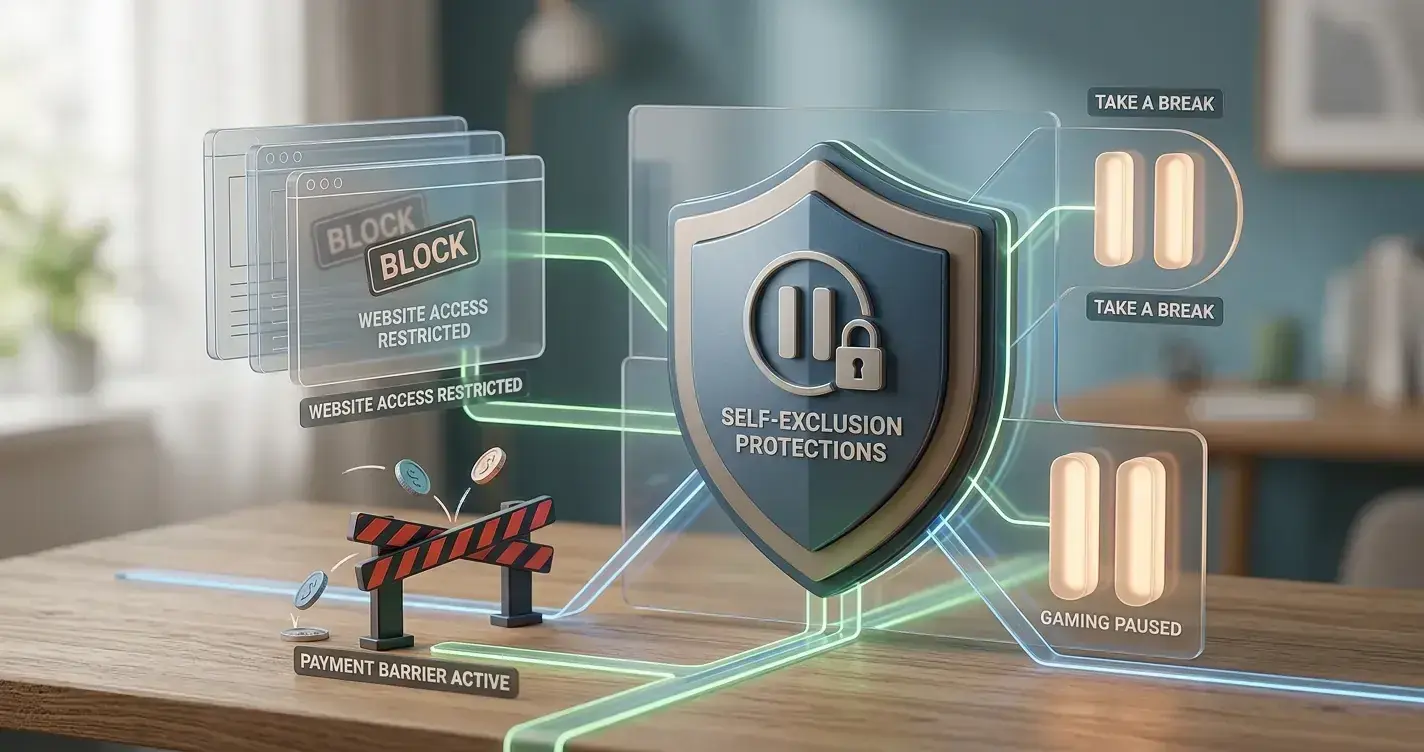
GAMSTOP covers the GB-licensed online gambling market
GAMSTOP is the national online multi-operator self-exclusion scheme covering gambling websites and apps run by businesses licensed in Great Britain. The Gambling Commission describes it as a way to make one self-exclusion request across participating licensed online operators rather than contacting each business separately.
That scope is the key fact for understanding Rollino. GAMSTOP coverage is not verified for Rollino, so readers should not assume that the scheme applies to the brand.
This page is about understanding protection, not finding ways around it. If you use self-exclusion, choose services and account settings that support the restriction you are trying to maintain rather than treating an offshore site as a workaround.
The full picture is in the Rollino review for UK players.
Why UKGC status matters to GAMSTOP coverage
The Gambling Commission’s current self-exclusion guidance ties GAMSTOP ONLINE to websites and apps run by gambling businesses licensed in Great Britain. Coverage follows the regulated British market; it is not created merely because a casino is available in English or can be reached from a UK internet connection.
GAMSTOP coverage is not verified for Rollino, so the scheme should not be assumed to apply to the brand.
The Rollino licence guide explains the distinction between its documented Curaçao licensing context and the separate UKGC requirement for businesses serving consumers in Great Britain.
Rollino’s own exclusion tools are a separate question
The supplied brand research partially verifies, through AskGamblers, that Rollino has documented self-exclusion and cool-off or time-out tools. This is useful, but it should not be described as equivalent to GAMSTOP. An operator-level control and a national multi-operator scheme have different scope.
Because the Rollino feature is only partially verified in the available evidence, this page does not invent exact durations, activation steps or reversal rules. If you need an account-level restriction, use current authenticated account information or support to confirm what is available and how it works.
If you are already using GAMSTOP or another self-exclusion measure, the goal should be to reinforce that boundary. Do not rely on a separate operator’s internal tools as proof that the same multi-operator protection applies.
Self-exclusion and a short cool-off are not identical
A cool-off or time-out can be designed as a temporary account break, while self-exclusion is a stronger restriction intended for someone who wants to stop gambling for a defined period. Exact Rollino options need current operator evidence, so this guide keeps the distinction conceptual rather than assigning unsupported durations to the brand.
Choose the control that matches the purpose. If the aim is to stop gambling because it is causing harm or becoming difficult to control, a stronger exclusion and broader barriers are more appropriate than treating a short break as a test of willpower.
For people in Great Britain using licensed online operators, GAMSTOP provides the multi-operator layer described by the Gambling Commission. Bank gambling blocks and blocking software can add separate barriers.
GAMSTOP is one layer, not the only layer
The Gambling Commission’s self-exclusion information also points consumers toward additional tools. Bank gambling blocks can stop card payments to gambling businesses, and gambling-blocking software can restrict access to gambling websites and apps. These layers work differently from operator self-exclusion.
Using more than one barrier can reduce the number of easy routes back to gambling during a vulnerable moment. The point is not to create a perfect technical wall; it is to make the protective decision easier to maintain when motivation changes.
If gambling is causing financial or emotional harm, support services can also help with the underlying problem. Technical blocks are useful, but they do not replace human support when that is needed.
What not to do if you are self-excluded
Do not treat a casino that appears outside a self-exclusion network as an opportunity to continue gambling. Searching for sites specifically because they are not blocked undermines the purpose of the restriction and can increase harm.
Likewise, do not create new identities, use another person’s payment method or look for technical ways around account restrictions. This guide will not provide bypass instructions. If a block is frustrating in the moment, add friction instead: step away from payment access, use blocking tools, contact someone you trust or seek gambling-support help.
For UK readers, the practical value of knowing GAMSTOP’s scope is to choose operators and protections that align with your safety needs, not to map gaps in coverage.
How to check whether protection applies
For GAMSTOP coverage, start with the operator’s UK Gambling Commission status. The Commission’s public register is the relevant source for whether an online gambling business is licensed in Great Britain. Do not infer coverage from a logo or an affiliate review.
For an operator’s own exclusion tools, check the authenticated responsible-gambling or account section and current terms. Ask support if the control’s effect is unclear. Because the supplied Rollino evidence is partial, current operator confirmation is especially important before relying on a specific internal tool.
Keep the two checks separate. A Rollino account tool, if available, does not establish GAMSTOP participation; GAMSTOP participation depends on the British licensed framework.
If your goal is to stop gambling
Use the broadest practical barriers available to you. In Great Britain, that can include GAMSTOP for licensed online gambling, bank gambling blocks and blocking software. Remove saved payment routes and marketing prompts where possible, and make it harder to reverse the decision impulsively.
If gambling is affecting your finances, relationships or wellbeing, consider contacting a gambling-support service rather than relying only on account settings. A self-exclusion tool is most useful when it is part of a wider plan to reduce access and get support.
Rollino-specific product features are secondary in this situation. The priority is maintaining the boundary you have chosen.
Rollino and GAMSTOP FAQ
Is GAMSTOP for all online casinos?
No. The Gambling Commission describes GAMSTOP ONLINE as covering gambling websites and apps run by businesses licensed in Great Britain.
Is Rollino on GAMSTOP?
V., so we do not claim verified GAMSTOP coverage.
Does Rollino have its own self-exclusion tools?
AskGamblers documents self-exclusion and cool-off or time-out tools, but this evidence is only partially verified here. Check current authenticated Rollino information for exact options.
Are Rollino’s tools the same as GAMSTOP?
No such equivalence is supported. An operator-level tool and a national multi-operator scheme have different scope.
Can you explain how to bypass GAMSTOP?
No. If you are self-excluded, use additional barriers and support to reinforce the restriction rather than looking for ways around it.
Decision summary
GAMSTOP belongs to the British licensed online-gambling framework. This guide does not promise that GAMSTOP covers Rollino. Separately, Rollino’s own self-exclusion and cool-off tools have partial third-party documentation.
For someone trying to control or stop gambling, the distinction should be used to strengthen protection: verify coverage, add bank or software blocks where useful, and seek support if account controls alone are not enough.
What the evidence can show
This page uses the available evidence at the level it supports. Platform ratings and documented tools are reported as source signals, not converted into stronger claims about every player or every account. Where a feature is only partially verified, current authenticated operator information is the appropriate place to confirm the exact behaviour.
That approach keeps the guide useful without overstating either risk or protection. Independent evidence can tell you what deserves attention; it cannot replace the facts of a specific account or a regulator’s current register.
Why multiple barriers can be useful
Self-exclusion works best when it reduces easy opportunities to reverse a decision during an impulsive moment. A multi-operator scheme can close access across a regulated group of sites, while bank blocks can reduce payment access and blocking software can add a device-level barrier. Each layer addresses a different route back to gambling.
No single tool needs to carry the entire burden. If one barrier is temporarily frustrating, another can create enough time for the urge to pass or for you to contact support. That is the practical reason to think in layers rather than searching for one perfect setting.
For Rollino specifically, do not assume partially documented internal controls provide the same scope as GAMSTOP. Confirm any operator-level tool you intend to rely on and use broader protections where they fit your situation.
If an exclusion tool is not working as expected
Do not respond by testing more gambling sites. Check the status of the exclusion through the service or operator that provides it, add another barrier such as a bank block or blocking software, and seek support if you are at risk of gambling despite wanting to stop.
If the problem is with an operator-level Rollino control, use authenticated support to ask what restriction is active and what it covers. Because the available evidence does not verify exact Rollino exclusion durations or activation rules, the current account response is more reliable than an old third-party description.
The goal is to restore the protective boundary, not to diagnose gaps in a way that makes them easier to exploit.
The licensing picture itself is on the trust page.
This material was created by the Rollino UK Guide team.
